Flood Water Pumps
When considering flood water pumps, there are different categories suited to different requirements, budgets, and environments.
This collection is intended for homeowners managing internal floodwater, Property Flood Resilience schemes, contractors and facilities teams responsible for flood response, and situations where emergency or backup pumping capacity is required.

The range brings together the most effective and commonly used flood pumps based on real-world and technical experience, including puddle pumps, submersible sump pumps, packaged pump stations, and engine driven pumps.
Flood & Water Pumps is operated by Flood Protection Solutions Ltd, an established UK company formed in 2012. Since then, we have supplied over 25,000 pumps for flood control and water management applications across the UK through floodandwaterpumps.co.uk. The pumps in this collection have been selected based on performance, reliability, and suitability for flood mitigation rather than generic water transfer.
The Stream SPK530 Puddle Pump has been used by the Environment Agency on its Floodmobile demonstration unit and is currently touring the country as part of Flood Re’s FloodPod programme with flood advocacy campaigner Mary Long-Dhonau OBE "FloodMary".

Historically, many flood losses have been worsened by the wrong type of pump being purchased, often pond pumps or automatic pumps that cannot pump to low levels. This collection is designed to avoid that mistake.
The three main types of flood water pump
- Puddle Pumps
- Submersible Pumps and Packaged Pump Stations
- Engine Driven Pumps
Puddle Pumps
A puddle pump is a specialist pump designed to remove water down to very low levels. They are often referred to as puddle suckers. They are sometimes incorrectly called skimmer pumps, which are designed to remove floating liquids rather than drain floodwater.

Puddle pumps are available in manual and automatic versions.
- Manual pumps are controlled at the plug.
- Automatic pumps detect water and switch on and off as required, usually using electronic sensors rather than float switches. Automatic puddle pumps are usually more expensive due to the engineering required to pump to low levels without overheating.
Some pumps, such as the EGO500Gi , can operate in either modes. In automatic mode it pumps down to approximately 60 mm before switching off. In manual mode it can pump as low as 10 mm.
Dependent on the model, automatic puddle pumps can require careful setup. Pumping to low levels without sufficient water for cooling can lead to overheating if incorrectly configured. Suitability depends heavily on the use case.

Puddle pumps are the most common pump used in flood protection because they are portable, cost effective, easy to deploy, and simple to store. They can be moved to wherever floodwater enters and are particularly effective behind Flood Barriers or in low points where water needs moving to a drain or safe discharge area.
Positioning a puddle pump at the lowest internal point allows water to be removed to very low levels and discharged safely away from the protected area. This approach is reactive but highly effective, and is frequently incorporated into practical flood defence setups.
They are also commonly used as part of Property Flood Resilience schemes to reduce internal water depth and limit damage. Most effective flood mitigation strategies include more than one pump.
A real example of a puddle pump used behind a flood barrier can be seen here:
Using an EVAK Residox Puddle Pump Behind a Flood Barrier
Most puddle pumps operate on 230V. Selected models including the Stream SPK530, Tsurumi LSC1.4S, and EVAK Residox are also available in 110V.
Further guidance on puddle pumps can be found here:
What Is a Puddle Pump and Why You Might Need One
Stream SPK530 Puddle Pump Featured on the Floodmobile
Why is the Tsurumi LSC1.4S Puddle Sucker so Popular?

Submersible Pumps and Packaged Pump Stations
Submersible pumps require greater water depth to operate safely, as the surrounding water provides cooling. For flood control they are typically installed in chambers and used with automatic level control.

There are several float switch options including arm floats, tube floats, and pendant floats. The correct choice depends on the chamber size and installation constraints.
A popular long-term solution is a packaged pump station. These systems combine a chamber, pump, pipework, and non-return valve into a single installed system. They are commonly used for flood mitigation and surface water drainage.
The main advantage of a packaged pump station is that it operates automatically without user intervention. During stressful flooding events this passive operation is often preferred. Many customers initially use puddle pumps for infrequent flooding and later upgrade to an installed system as flooding becomes more regular.

Simon Crowther, Founder of Flood Protection Solutions Ltd, notes:
“Having been flooded in 2007, I understand the reality of flood events. We initially used a puddle pump, but over time installed an Iguazu packaged pump station. After the property was sold, the next flood occurred while the new owners were overseas. The pump station activated automatically and kept the house dry.”
If an existing chamber is already in place, submersible pumps in this collection have been selected specifically for flood control, ranging from compact units to high-capacity pumps such as the APP HD-15 with flow rates up to 830 litres per minute.
Pump selection should be based on inflow rate and chamber size rather than maximum capacity. Oversized pumps in small chambers can short cycle, leading to premature failure.
Non-return valves are essential when pumping vertically or uphill, particularly in basements. Without one, discharged water can flow back into the chamber when the pump stops, causing rapid cycling and increased wear.
Simon Crowther advises:
“I visited a property in Oxfordshire where a basement pump was constantly cycling. The issue was simple. There was no non-return valve. Every time the pump switched off, the water in the vertical pipe flowed back into the chamber and triggered it again. This would have caused early failure and unnecessary energy use.”
Packaged pump stations include non-return valves as standard. Some standalone pumps also include them, but it is always something to check.
Further reading:
- Learn about sump pumps in flood resilience → Sump Pumps and Property Flood Resilience
- See a real installation case study → Installing a sump pump for surface water flooding (case study)

Engine Driven Pumps
Engine driven pumps are typically used where there is no electrical supply or where very high flow rates are required. The most common example is the Honda WB20.
Most engine driven pumps are centrifugal pumps and require priming. They also rely on sufficient water depth to operate. Due to high flow rates, they often require monitoring to avoid running dry.

At full discharge, a Honda WB20 will typically run for just over 90 minutes on a tank of fuel. Many flood events last far longer, making fuel management and supervision necessary. Stored fuel can degrade over time, adding further reliability considerations.
Engine driven pumps are therefore best suited as backup equipment or for short-term tasks such as:
- Draining sites
- Removing floodwater
- Water transfer
- Construction dewatering
- Agricultural use
They cannot be used internally and unlike a submersible pump which is placed in the water, the engine driven pumps must be placed outside or above the flood water, drawing water via a suction hose and delivering it via a discharge hose.
Engine Driven Diaphragm Pumps in Flood Response
An alternative to engine driven centrifugal pumps is a diaphragm pump. Instead of using a spinning impeller, a diaphragm pump physically displaces water using a flexible membrane. This means it does not rely on velocity or a flooded volute and does not need priming.
This makes diaphragm pumps particularly effective where water levels are low, flow is intermittent, or water is muddy or debris-laden.
Advantages include:
- No loss of prime
- Better tolerance of air in suction lines
- Improved performance in silty or contaminated water
Centrifugal pumps in the same conditions may cavitate, lose prime, or overheat.
The trade-off is cost and lower flow rates. Diaphragm pumps are therefore typically used by emergency services, contractors, and agencies. Models such as the Tsurumi TD petrol diaphragm pump and DryMax diesel diaphragm pumps are highly effective for specialist flood response applications.
A simple rule of thumb:
- Clean water, known levels, high volume: centrifugal pump
- Dirty water, uncertain levels, flood response: diaphragm pump
Engineering Reality and Redundancy
All pumps are mechanical equipment. Even high-quality pumps can fail. Good flood engineering always includes redundancy.
Where a pump is relied upon for flood control, a spare should always be available. In some situations multiple pumps may be required if inflow exceeds expectations.
Even with flood walls and Property Flood Resilience measures, water can enter through walls or rise through the ground due to hydraulic pressure. Longer duration floods often increase this effect.
This page provides guidance on suitable flood water pumps but is not a substitute for engineering design. The pumps shown here represent some of the most effective flood water pumps currently available for real flood scenarios.

Floodandwaterpumps.co.uk is a UK company with its warehouse based in Nottinghamshire. The team is available to assist with enquiries, although online ordering is encouraged to ensure the best pricing and timely processing. A UK office handles telephone support where required. The focus is on supplying reliable, well-selected water pumps with dependable service. Selected models are also supplied through Amazon, where the company is an established best seller of puddle pumps.
Filters
-
Original price £495.00 - Original price £495.00Original price£495.00 £594.00£495.00 - £495.00Current price £495.00 £594.00 £594.00| /
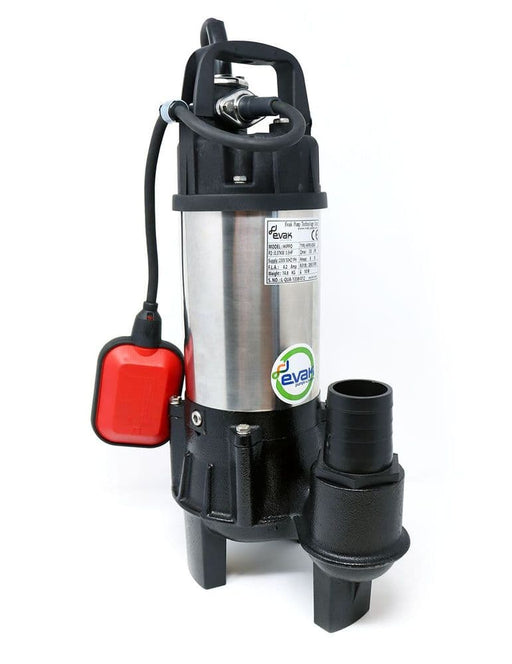
Evak Hippo 200 Sewage Pump (15m Head Lift, 50mm Outlet) DN50-200
EVAK- Impressive Solids Handling (50mm free passage)
- Perfect for sewage, drainage and dirty water
- Heavy Duty
- Impressive Flow Rate
Hippo 200 Submersible Sewage Pump (230V & 400V) The Hippo 200 is a robust submersible sewage and dirty water pump designed for demanding domest...
View full detailsOriginal price £495.00 - Original price £495.00Original price£495.00 £594.00£495.00 - £495.00Current price £495.00 £594.00 £594.00| / -
FromOriginal price £765.00 - Original price £840.00Original price£765.00 £918.00£765.00 - £840.00Current price £765.00 £918.00 £918.00| /
FPS Iguazu Sump FEKA | Stainless Steel Sewage Pump Station (FEKA VS 750)
Flood Protection Solutions- Simple to install
- Sewage Pump
- Quiet in operation
The FPS Iguazu Sump FEKA is a premium packaged pump station, expertly designed to collect foul water from basements, ground floor extensions, or an...
View full detailsFromOriginal price £765.00 - Original price £840.00Original price£765.00 £918.00£765.00 - £840.00Current price £765.00 £918.00 £918.00| /