

Plastica
Plastica iFlo Pool Pump | Small Pools, 230V
- Best for Small Pools
- Quiet, cost-effective option
- Handles clean or lightly dirty water
- Ideal for basic domestic use
£269.00
£224.17 (Exc VAT)
Only 4 left
A swimming pool pump is the heart of the pool’s circulation system. It draws water from the pool, moves it through the system – typically via a filter – and returns it clean and clear. Without a functioning pump, water quickly becomes st...
A swimming pool pump is the heart of the pool’s circulation system. It draws water from the pool, moves it through the system – typically via a filter – and returns it clean and clear. Without a functioning pump, water quickly becomes stagnant, chemicals are not properly distributed, and heat cannot circulate effectively. We supply four trusted ranges of swimming pool pumps from Plastica and Speroni, covering domestic, above-ground, ornamental and commercial pools. All of our swimming pool pumps are surface pumps, meaning they sit dry alongside the pool rather than being submerged in the water. Surface pumps draw water in through a suction line, push it through the filter, and return it to the pool. They are housed in a pump room, plant room, or weatherproof enclosure, and are the standard configuration for swimming pool circulation.
Choosing the right swimming pool pump comes down to two things: flow rate and head. Your pump must circulate all the water in your pool through the filtration system within a set period, typically 8 hours for a domestic pool, and it must do so against the resistance of your pipework, filter, and fittings combined. Get either wrong and the pump will either struggle to keep the water clean or wear out prematurely.
We have a step-by-step guide and video on how to choose a swimming pool pump which walks you through the process manually in 5 easy steps. Our calculator below takes this further, and our guide to how to size a swimming pool pump explains the method behind it and how to read the result against a pump curve.
It works through the same flow rate calculation but also factors in an estimated total head based on your suction lift, filtration system resistance, pipework, and return height, then identifies pumps from our range that meet both requirements simultaneously.
Please note: all results are indicative only. The calculator uses simplified assumptions and a linear pump curve approximation. Before purchasing, always verify the pump’s performance against its published curve at your required head, and check that the pump’s inlet and outlet sizes are compatible with your existing pipework and fittings.
Select your available voltage. This filters the pump range shown in the results.
Standard domestic supply
Use average depth if the pool has a sloping floor
How long should it take to circulate all pool water through the filtration system?
Recommended for most domestic pools
The pump must overcome resistance from four sources. Adjust the values below to match your installation. The defaults are typical for a standard domestic pool.
From compact above-ground pools to high-duty commercial systems, our four pump brands cover the full spread of UK pool installations. Every model is chosen for proven reliability in real systems, not headline box figures.
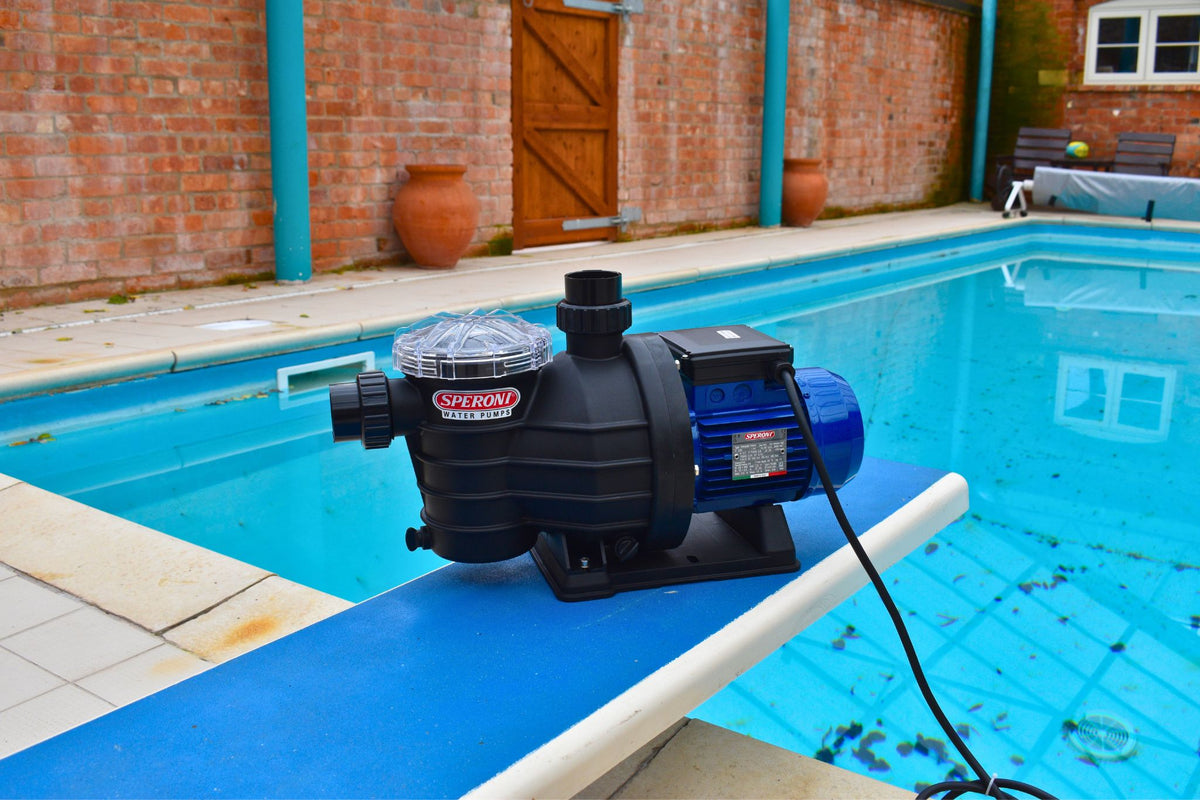
Pictured is the Speroni SWIMM, our high-head workhorse for pools with long pipe runs, heaters and high-resistance filters. Alongside it we stock the British-built Plastica iFlo, AG and Argonaut ranges, the Pentair line-up of variable-speed, commercial and self-priming pumps (Swimmey VSE, Sta-Rite and Freeflo), and the salt-friendly ESPA Repospool, across 230V single-phase and 400V three-phase. The comparison table and buying guide below show which suits which pool.
Below is a short video, How to Choose a New Swimming Pool Pump in 5 Easy Steps, which explains the basics of pump selection in a simple, practical way, focusing mainly on flow rate.
It's intended as a guide to help you understand the theory, but it is indicative only and does not account for system head or friction losses. We can't specify a pump remotely without understanding the full site setup, pipework and system resistance.

Compare our pool pump ranges side by side: what each is best at, its flow and head, and whether it suits a salt pool. Everything you need to narrow it down.
| Range | Best for | Max flow | Max head | Salt-safe | Power | |
|---|---|---|---|---|---|---|
| Swimmey VSEPentair | Efficiency, low running cost | 100–270 L/min | 15 m | – | 230V | View → |
| SWIMMSperoni | High head, long pipe runs | 250–450 L/min | 11–24 m | – | 230V/400V | View → |
| Sta-Rite 5P2RPentair | Heavy-duty, commercial | 200–367 L/min | 12–22.5 m | – | 230V/400V | View → |
| FreefloPentair | Above-ground, self-priming | 150–258 L/min | 11–17 m | – | 230V | View → |
| RepospoolESPA | Salt pools, adjustable flow | 367 L/min | 16 m | Yes | 230V | View → |
| Argonaut AVPlastica | Large & commercial pools | 216–533 L/min | 11–18 m | Yes | 230V/400V | View → |
| AGPlastica | Quiet, above-ground | 150–266 L/min | 8–13 m | Yes | 230V | View → |
| iFloPlastica | Budget, smaller pools | 166–283 L/min | 10–17.5 m | – | 230V | View → |
The deeper read: the four pump ranges we stock, the three numbers that matter, and how to pick the right pump for your system.
The best swimming pool pump for your pool is the one sized to circulate the whole pool in about eight hours at your system's real head. For most smaller domestic pools that is the value Plastica iFlo or the quiet, salt-safe Plastica AG, while larger pools, commercial systems and setups with long pipe runs, heaters or high-resistance filters are better matched to the Plastica Argonaut, the high-head Speroni SWIMM or the heavy-duty Pentair Sta-Rite. For the lowest running cost there is the variable-speed Pentair Swimmey, for above-ground pools the self-priming Pentair Freeflo, and for salt pools the ESPA Repospool. Here is how the four brands compare; the table above breaks it down model by model.
| Brand | Ranges | Best for | Salt-safe | Supply |
|---|---|---|---|---|
| Plastica | iFlo, AG, Argonaut | UK-built; value through to commercial duty | AG & Argonaut | 230V / 400V |
| Speroni | SWIMM | High head: long runs, heaters, high-resistance filters | No | 230V / 400V |
| Pentair | Swimmey VSE, Sta-Rite, Freeflo | Variable-speed efficiency, commercial, self-priming | No | 230V / 400V |
| ESPA | Repospool | Salt pools, adjustable flow | Yes | 230V |
We stock four brands, and between them a range that covers every kind of UK pool, from above-ground pools with the Plastica AG or self-priming Pentair Freeflo, through to large commercial systems on three-phase power with the Plastica Argonaut or Pentair Sta-Rite.
230V single-phase is the standard domestic supply for smaller, typical home pool pumps, while 400V three-phase is used for larger or commercial pumps where higher power, better efficiency, and smoother operation are required.
We don’t stock budget pumps built to fail after a season or two. Every model in our range has been selected for its proven reliability and suitability for real-world pool systems.
Plastica iFlo (entry-level, smaller pools)
The iFlo is the most affordable pump in our range. It is a simple, reliable, cost-effective pool pump designed for smaller residential pools and straightforward circulation loops. British-engineered by Plastica, who have been manufacturing pool equipment in the UK since 1972. Easy to fit, easy to replace, with a 2-year warranty on the electronics. The right starting point for a standard domestic pool when budget is a priority.
Plastica AG Series (quiet, above-ground and ornamental)
Mid-range Plastica pump with ultra-quiet operation at approximately 55 dB. Designed for above-ground pools and ornamental ponds where low noise matters. Built with materials that handle saltwater, so suitable for salt-chlorinated systems as well as standard chlorinated pools. The quietest pump we sell.
Plastica Argonaut AV Series (premium, larger and commercial pools)
Plastica's premium pool pump. Higher flow capacity, heavier-duty build, and capable of handling saltwater. Designed for larger residential pools and commercial systems where the pump is running long hours every day. Choose Argonaut if your pool is over 60,000 litres, runs more than 8 hours a day, or needs a pump built for sustained continuous duty. For the single-phase and three-phase options across the AV range, see our guide to the Plastica Argonaut AV range.
For a fuller comparison of how iFlo, AG and Argonaut sit alongside each other in the Plastica range, read our guide: Understanding the Plastica Range of Swimming Pool Pumps.
Speroni SWIMM (high head, continuous duty)
Italian-engineered by Speroni, the SWIMM is a continuous-duty pool pump and one of our most popular models thanks to its high-head performance. It handles systems with long pipe runs, heaters and high-resistance filters that would push other pumps off their working curve. The models cover everything from compact pools to larger domestic and commercial systems. Removable filter basket, inspection cover, and both 230V and 400V models available.
Pentair Swimmey VSE (variable speed, lowest running cost)
The Swimmey VSE is our variable-speed pool pump. Rather than running flat out, you set the speed to the flow your pool actually needs, which cuts energy use sharply over a season of daily running. Flow is adjustable from around 100 to 270 litres per minute, so one pump covers a wide range of pool sizes, and it is the model to choose when running cost is the priority. Engineered by Pentair, one of the largest names in pool equipment worldwide.
Pentair Sta-Rite 5P2R (heavy-duty and commercial)
The Sta-Rite is a robust, heavy-duty pump built for demanding and commercial installations. It delivers up to around 367 litres per minute against up to roughly 22.5 metres of head, with 230V single-phase and 400V three-phase options for larger sites. Choose it where the pump runs long hours and reliability under load matters most.
Pentair Freeflo (above-ground and self-priming)
The Freeflo is a self-priming pump aimed at above-ground pools and installations where the pump sits at or above water level and needs to draw water up to prime itself. It covers roughly 150 to 258 litres per minute at up to about 17 metres of head on a 230V supply, a straightforward, dependable choice for a typical above-ground setup.
ESPA Repospool (salt pools, adjustable flow)
The Repospool is our dedicated salt-pool pump, built by ESPA with materials chosen to resist salt-chlorinated water. It offers adjustable flow up to around 367 litres per minute at about 16 metres of head on a 230V supply. If you run a saltwater pool, this is the purpose-built option alongside the salt-capable Plastica AG and Argonaut.
Five specifications decide whether a pool pump will perform well in your system, and our product pages publish them clearly. If you are replacing an existing pump, you can read all five off its data plate, the sticker or stamped panel on the motor body.
Flow rate
Flow rate is the volume of water the pump moves, quoted in litres per hour (sometimes litres per minute). The industry standard is to circulate the entire pool volume once every 8 hours. So if your pool holds 40,000 litres, you need a pump rated to move at least 5,000 litres per hour at your system's working head.
Bigger is not better. Oversized pumps cost more to run, overpower the filter, strain the seals, and fail early. Matching the flow rate is the single most important decision.
Head
Head is the resistance the pump has to push against. It includes the height it has to lift water, plus friction loss from pipework, filters, heaters and fittings. It is measured in metres.
As a working guide, 10 metres of head is roughly equivalent to 1 bar of pressure. The total head for any given pool depends on its size, pipe runs, filtration setup and return height, so it varies significantly from one installation to the next. The pump's published flow rate must be the flow rate at your head, not the headline figure quoted on the box, which is the maximum at zero head.
Long pipe runs, sand filters, heat pumps and salt cells all add to total head. Systems with high total head are where the Speroni SWIMM tends to outperform other pumps in the category.
Voltage and phase
Every brand we stock offers a standard 230V single-phase mains supply, with 400V three-phase options across the Plastica Argonaut, Speroni SWIMM and Pentair Sta-Rite ranges.
If you are replacing a like-for-like pump, voltage is rarely an issue, but it is worth checking the existing pump's plate before ordering.
Pipe and connection size
Most domestic pool pumps use 1.5 inch or 2 inch unions. Matching the existing connection size keeps the pipework swap simple and avoids adapters.
Power
The motor rating is marked on the data plate in watts or kilowatts; older or imported pumps may show horsepower instead, where 1 HP is roughly 0.75 kW. Treat it as a sense check that the new pump is in the same class, not the deciding figure: flow rate and head determine whether a pump suits your pool, and a higher power rating on its own usually just means higher running cost.
Three components do the work, and understanding them will tell you why a pump fails and how to extend the next one's life.
Although designed for chlorinated swimming pools, our pumps cover a wider range of applications:
If your existing pump has run reliably for many years, a like-for-like replacement is often the sensible option. However, if it failed prematurely or struggled to keep the pool clear, it was likely the wrong pump for the system in the first place, so a quick sanity check is worthwhile before replacing.
It is also worth noting that many pumps have been rebranded or updated over time, so a direct equivalent is usually available even if the original model is no longer listed.
Our step-by-step guide on how to replace a swimming pool pump walks through removing the old unit and fitting the new one. Orders placed before 2pm are dispatched on a next working day service.
We can provide indicative guidance based on the information available, but this does not constitute a design or engineering review.
FloodAndWaterPumps.co.uk is a UK specialist pump supplier, part of Flood Protection Solutions Ltd and established in 2012. We specialise in pumps and water movement rather than selling pumps as one product category among thousands.

If you need to empty a swimming pool rather than circulate and filter the water, you need a drainage pump rather than a conventional swimming pool pump.
Our Swimming Pool Draining Pump Kit is built specifically for this job. It combines a corrosion-resistant Mizar 60 submersible pump with 10m of reinforced 32mm hose and all the fittings needed to start pumping.
The pump is lowered directly into the pool and discharges the water through the supplied hose.
It is ideal for emptying pools for maintenance, repairs, cleaning, winterisation or water replacement.
Size on flow rate and head, not horsepower. The industry standard is to circulate your whole pool once every eight hours, so divide your pool volume in litres by eight to get the litres per hour you need, then choose a pump that delivers that flow at your system’s actual head, not the headline figure on the box. Our free pool pump sizing calculator works it out, and our 5 easy steps guide explains the method.
There is no single best pump; the right one is matched to your pool. For most smaller domestic pools the Plastica iFlo (best value) or AG (quietest, salt-safe) suits, while larger or commercial pools and systems with long pipe runs, heaters or high-resistance filters are better served by the Plastica Argonaut, the high-head Speroni SWIMM or the heavy-duty Pentair Sta-Rite. For the lowest running cost look at the variable-speed Pentair Swimmey, and for salt pools the ESPA Repospool. Our guide to the Plastica range of swimming pool pumps compares the Plastica models side by side.
Long enough to circulate the whole pool volume at least once a day, which is where the eight-hour turnover figure comes from. Many domestic pools run the pump around 8 hours a day, more in hot weather or heavy use and less in winter. Because running cost scales with hours, correct sizing matters, which we cover in our guide to pool pump running costs.
It depends on the pump’s power and how many hours a day it runs. Since a pool pump runs for hours daily through the season, an oversized pump is expensive to run, which is the main reason to size it correctly. We work through the figures, and how to reduce them, in our guide to pool pump running costs.
Yes, but only with a pump built for it. Salt-chlorinated water is corrosive, so choose a salt-safe pump: the purpose-built ESPA Repospool, the Plastica AG or the heavier-duty Plastica Argonaut, which use materials that resist salt. A standard pump not rated for salt will corrode and fail early. See our guide to the Plastica Argonaut AV range for one salt-capable option.
Read the old pump’s data plate for its flow, head, voltage and connection sizes and match those rather than the horsepower. If it failed early it may have been the wrong pump, so a quick sizing check is worthwhile. Our step-by-step guide to replacing a swimming pool pump covers removing the old unit and fitting the new one.
FloodAndWaterPumps.co.uk is part of Flood Protection Solutions Ltd, a UK specialist pump supplier established in 2012. We are not a generic online retailer. Our team includes engineers with real-world experience in water management, drainage and flood resilience.
The products we supply are selected based on how they perform in real installations, not just catalogue specifications. This means you get pumps that are proven, correctly specified, and supported by practical advice when you need it.
This is usually caused by a blockage (pump basket, skimmer or filter), an air leak on the suction side, or the pump being unable to overcome the system resistance. Air leaks and clogged impellers are among the most common causes of poor circulation.
Minor issues like seals, baskets or capacitors can often be repaired. However, if the motor has failed or the pump is several years old, replacement is usually more cost-effective. In many cases, repeated failures indicate the pump was not correctly sized for the system.
Noise is typically a sign of a problem rather than just age. Common causes include worn bearings, cavitation (running without enough water), poor mounting, or debris in the impeller. Ignoring it often leads to full failure if not addressed early.
Yes. Regularly emptying the pump basket, checking seals, and ensuring good airflow around the motor are essential to prevent overheating and premature failure. Most common pump issues are avoidable with basic maintenance and periodic checks.


