


When a pool pump fails, the water can turn cloudy within days, so most people want a replacement fast. The instinct is to grab the nearest like-for-like model and move on. That works if the original pump was correctly specified, but if it failed early or always struggled to keep the pool clear, fitting the same thing again just repeats the original mistake. A few minutes spent reading the old pump first is what turns a panic buy into a clean, correct swap.
This guide covers the failure signs to watch for, how to decide between repair and replacement, exactly which numbers to read off the old pump, and how to match them to a new one.
Signs your pool pump is on the way out
A pool pump rarely dies without warning. The common signs, and what usually causes each one, are:
- Loss of prime or weak circulation: normally a blocked pump basket, skimmer or filter, or an air leak on the suction side. Worth ruling out before you condemn the pump.
- Noisy bearings, humming or vibration: typically worn bearings, cavitation (the pump running short of water), or debris in the impeller. Noise is a sign of a problem, not just age, and left alone it often ends in full failure.
- Losing pressure: the filter gauge or return jets weaken. Often a clogged basket or filter, an air leak, or an impeller worn or partly blocked.
- Leaking from the shaft: a worn mechanical seal. This one may be repairable on its own.
- Tripping the electrics or cutting out on heat: commonly a failing motor, or a pump that is undersized and running too hard for the system.
Repair or replace? When each makes sense
Minor parts are usually worth repairing: a pump basket, a shaft seal, a fuse.
If the motor has burned out, or the pump is several years old and on its second or third fault, replacement is almost always the better value. The point most retailers skip is this: repeated failures usually mean the pump was the wrong size or type for the system, not that you were unlucky. A pump starved of water through a blocked intake, or pushed beyond its head, wears out early no matter how good it is. So if you are replacing a pump that never quite coped, treat it as a chance to size the new one properly rather than copy the old spec.
Reading the data plate: the numbers that must match
Before ordering, find the data plate on the old pump (a sticker or stamped panel on the motor body) and note these five things. They are what make a replacement a clean swap rather than a gamble.
- Flow rate, in litres per minute or litres per hour: the volume the pump moves.
- Head, in metres: the resistance the pump is rated against. As a working guide, 10 metres of head is roughly 1 bar.
- Voltage and phase: 230V single phase is the standard domestic supply; 400V three phase is used on larger and commercial pumps. Replacing like for like rarely changes this, but check the plate before ordering.
- Pipe and connection size: most domestic pool pumps use 1.5 inch or 2 inch unions. Matching this keeps the pipework swap simple.
- Power, in watts or kilowatts (sometimes horsepower): the motor rating is marked on the plate in W or kW, and older or imported pumps may show it in horsepower (HP) instead, where 1 HP is roughly 0.75 kW. It is a useful sense check that the new pump is in the same class, but treat it as secondary: flow rate and head decide whether a pump suits your pool, and a higher power rating on its own usually just means higher running cost.
If the old pump ran reliably for years, matching these figures is a sound choice. Note too that many pumps have been rebranded or updated over time, so a direct equivalent is often available even when the original model is no longer listed.
Matching flow and head to your pool's turnover
If you are taking the opportunity to right-size, the method is the same one in our guide to choosing a pool pump. Aim to turn the whole pool over through the filter once every 8 hours for a domestic pool, or every 6 hours where bather loads are high. Divide your pool volume in litres by the turnover hours, then by 60, to get the flow you need in litres per minute.
It is also worth remembering that many residential customers do not run the pump 24 hours a day, only for a few hours, and this run time is a factor in circulation too, because the aim is to turn the whole pool volume through the filter during the day.
The figure that catches people out is head. The flow that matters is the flow your pump delivers at your system's head, not the headline maximum on the box, which is measured at zero head. Long pipe runs, sand filters, heat pumps and salt cells all add resistance. Our Water Pump Performance Calculator estimates the friction in your pipework, the pump curve guide shows how to read flow and head together, and the calculator on our swimming pool pumps page matches both against our range for you.
One rule holds throughout: bigger is not always better. An oversized pump costs more to run, can overpower the filter by pushing water through too fast, and strains the seals. Choose the smallest pump that comfortably meets your flow and head.
Same footprint, easier swap: union connections and pipe size
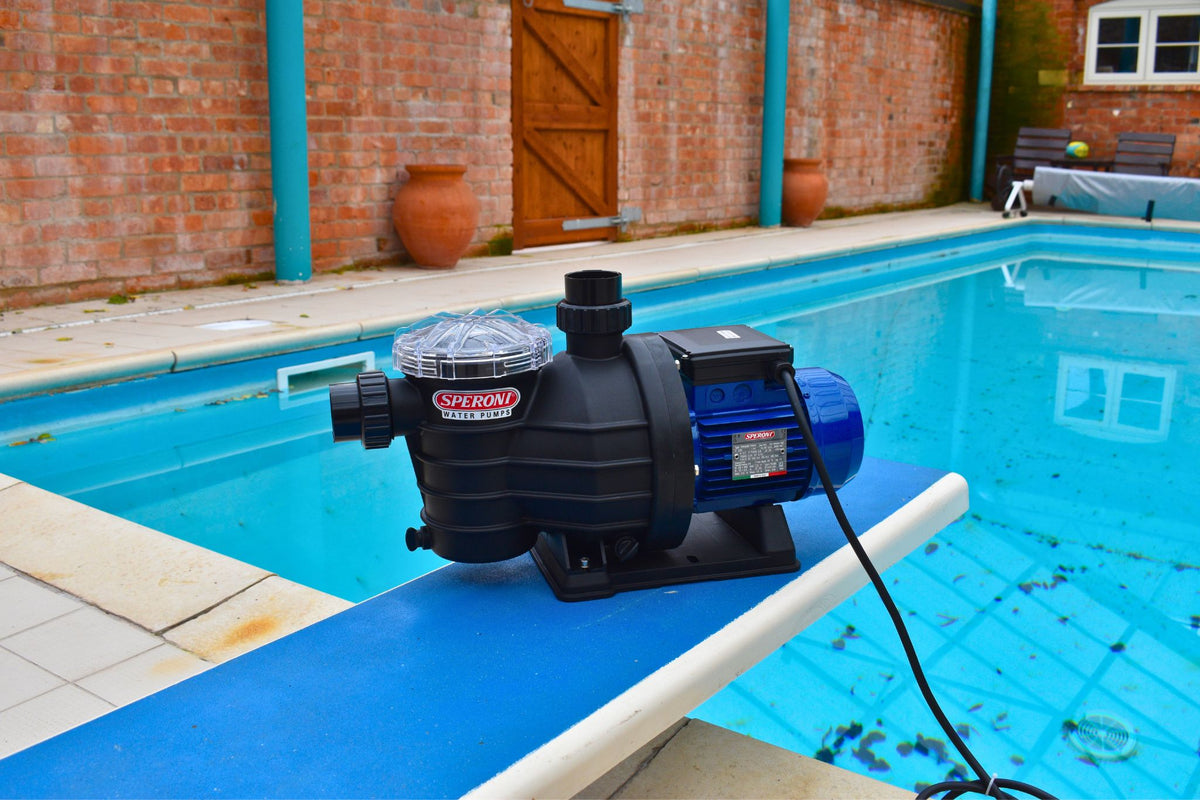
A pool pump is a surface pump: it sits dry beside the pool, not in the water. The easiest replacements are the ones that match the old pump's connections, so you are not re-plumbing. Check the union size (commonly 1.5 inch or 2 inch), the inlet and outlet positions, and the base footprint. Most of our pool pumps use union connections, which let you disconnect the old pump and connect the new one without cutting pipework. If the new pump's connections differ, simple adaptors usually bridge the gap, and our team can confirm what you need before you order.
Our four brands cover most installations: the Plastica iFlo for smaller domestic pools, the quiet Plastica AG for above-ground and ornamental pools, the heavier-duty Plastica Argonaut AV for larger and commercial pools, and the high-head Speroni SWIMM for systems with long runs, heaters or high-resistance filters. Alongside them we stock the Pentair Swimmey VSE variable-speed pump for the lowest running cost, the heavy-duty Pentair Sta-Rite and self-priming Pentair Freeflo, and the purpose-built ESPA Repospool for salt pools. Saltwater pools should use the ESPA Repospool, Plastica AG or Argonaut, all built for the corrosive conditions. For a fuller comparison, see our guide to the Plastica range.
Send us your old model and we will match it
If you would rather not work it out alone, send us the make and model from your old pump, along with your pool volume and a note of the pipe size, and we will find the right equivalent. You can also browse the full range of swimming pool pumps, use the Pump Finder, or read our troubleshooting guide if you are not yet sure the pump is the problem. Orders placed before 2pm are dispatched the same working day. For help, call the team on 0115 987 0358.

Frequently asked questions
Should I repair or replace my pool pump?
Minor parts such as the basket, shaft seal or capacitor are often worth repairing. If the motor has failed, or the pump is several years old and on a repeat fault, replacement is usually more cost-effective. Repeated failures often mean the pump was the wrong size for the system in the first place.
How do I find a direct replacement for my pool pump?
Read the data plate on the old motor and note the flow rate, head in metres, voltage and phase, and connection size, then match those figures to a new pump. Many models have been rebranded or updated over time, so a direct equivalent is usually available even if the original is no longer listed. Send us the make and model and we will match it.
Why is my pool pump losing pressure?
Most often a blocked pump basket or filter, an air leak on the suction side, or a worn or partly blocked impeller. Check and clean the basket and filter and look for air leaks first. If pressure stays low after that, the impeller or motor may be worn, which points to replacement.
Can I just replace a pool pump with the same horsepower?
Horsepower alone is not enough. The figures that decide performance are flow rate and head, read together at your system's actual resistance. Two pumps of the same horsepower can deliver very different flow at the head of your installation, so match flow and head, not just the motor rating.
Will a new pump fit my existing pipework?
Usually yes, if you match the union and pipe size, commonly 1.5 inch or 2 inch on domestic pools. Most of our pool pumps use union connections for a straightforward swap, and simple adaptors bridge small differences. Check the connection size on the old pump before ordering, or send us the details and we will confirm.


